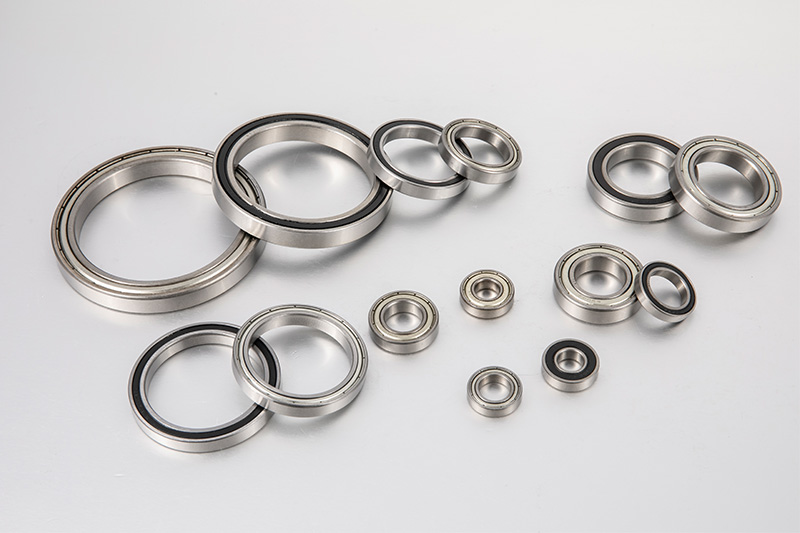
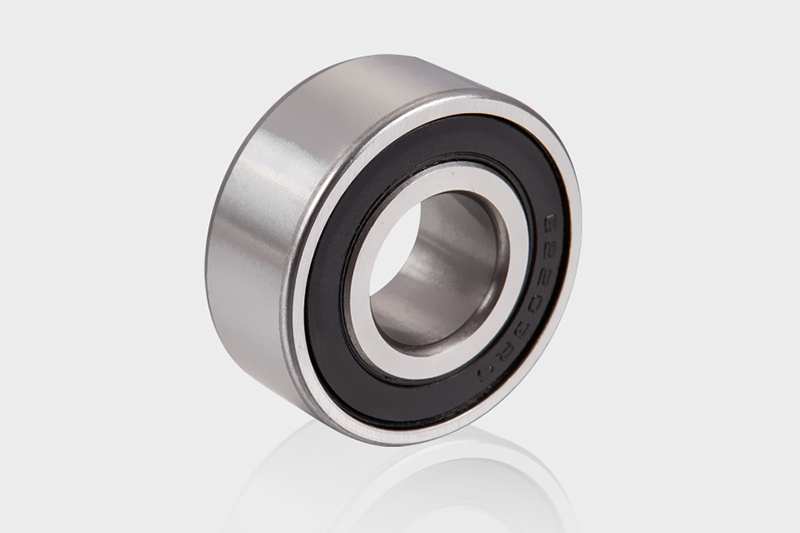
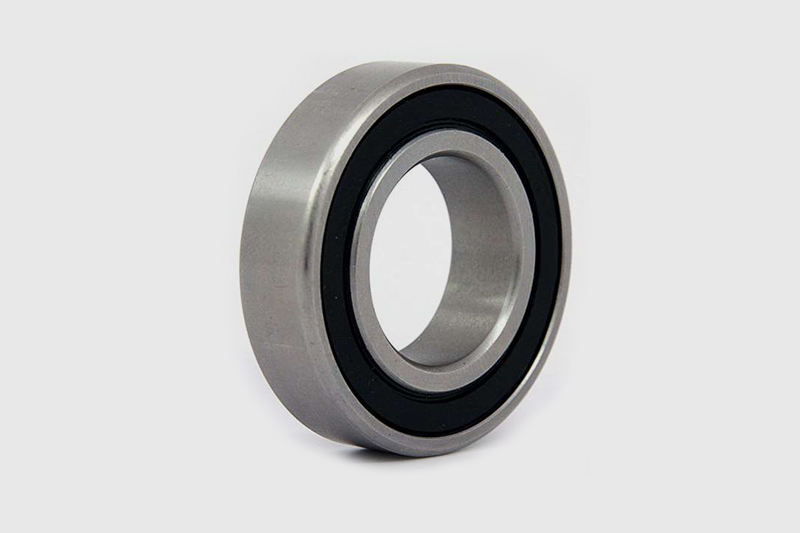
Series 1600 Chrome Steel Deep Groove Ball Bearing
Product Overview The Series 1600 Deep Groove Ball ...




Content
For combined radial and axial loads, choose a deep groove ball bearing when axial load stays below 30–40% of radial load and speeds are moderate to high. Switch to angular contact ball bearings when axial load is significant, sustained, or directionally defined — typically when Fa/Fr exceeds 0.35–0.5, or when axial stiffness is critical to system performance. The decision comes down to three core variables: load ratio, speed, and whether the axial force is unidirectional or bidirectional.
Deep groove ball bearings (DGBB) handle combined loads through their deep raceway geometry. The groove depth allows the bearing to generate a moderate contact angle under axial loading — but this angle is not fixed. It varies with load magnitude, which makes axial stiffness inconsistent and harder to predict under fluctuating conditions.
Angular contact ball bearings (ACBB) are built with a fixed, designed-in contact angle — typically 15°, 25°, or 40°. This means the load path through the bearing is defined from the start. A 25° contact angle bearing can carry roughly twice the axial load of a comparably sized DGBB at the same equivalent load rating, while still handling substantial radial forces.
The structural difference matters in practice: under the same combined load of Fr = 6 kN radial and Fa = 3 kN axial, a 6206 DGBB calculates an equivalent load P ≈ 6.84 kN, while a 7206 ACBB (25° contact angle) with higher C rating distributes that same load more efficiently, yielding a longer computed L₁₀ life by a factor of 1.5–2× depending on exact ratings.
Contact angle is the most important design parameter in angular contact bearings. It directly governs the trade-off between radial capacity, axial capacity, and speed capability:
As a guideline: every 10° increase in contact angle roughly doubles the axial load factor Y, allowing the bearing to absorb proportionally more thrust before equivalent load P becomes life-limiting.
Angular contact ball bearings are inherently single-direction thrust bearings — a single ACBB can only support axial load in one direction. This is a key constraint that drives mounting arrangement decisions.
A single angular contact bearing in a fixed/float arrangement is sufficient. The fixed end carries all axial load in one direction; the float end handles pure radial load with a DGBB or cylindrical roller bearing. Typical in: fan shafts, centrifugal pump impellers, single-helix gear shafts.
Paired angular contact bearings are required. Two standard configurations are used:
A deep groove ball bearing handles bidirectional axial load inherently in a single unit — this is a practical advantage in compact or cost-sensitive designs where axial load levels remain moderate.
Deep groove ball bearings generally outperform angular contact bearings at high speeds in open or lightly lubricated conditions. The symmetric load distribution reduces gyroscopic spinning forces on the balls. For a given bore size, DGBB limiting speeds are typically 15–25% higher than equivalent ACBB under grease lubrication.
| Bearing | Type | Grease Speed Limit (rpm) | Oil Speed Limit (rpm) | Contact Angle |
|---|---|---|---|---|
| 6206 | Deep Groove | 13,000 | 17,000 | Variable (load-dependent) |
| 7206 B (15°) | Angular Contact | 12,000 | 15,000 | 15° |
| 7206 AC (25°) | Angular Contact | 10,000 | 13,000 | 25° |
| 7206 C (40°) | Angular Contact | 8,500 | 11,000 | 40° |
At speeds above 80% of the grease speed limit, thermal management and lubrication method become critical regardless of bearing type. In these regimes, DGBB with low-viscosity grease or oil-air lubrication often delivers better thermal performance than ACBB.
When shaft positioning accuracy matters — such as in machine tool spindles, precision gearboxes, or servo-driven axes — angular contact bearings in preloaded pairs are almost always preferred. Preloaded DB-paired angular contact bearings achieve axial stiffness values of 100–400 N/μm depending on preload class, compared to 20–80 N/μm for a single DGBB under typical operating conditions.
For applications where positional accuracy is not a design requirement — such as agricultural equipment, conveyor rollers, or domestic appliance motors — the stiffness advantage of angular contact bearings does not justify the additional cost and mounting complexity.
Deep groove ball bearings offer a significant practical advantage in cost and simplicity:
| Condition | Recommended Bearing | Reason |
|---|---|---|
| Fa/Fr < 0.3, general purpose | Deep Groove Ball Bearing | Sufficient axial capacity, lower cost, simpler mounting |
| Fa/Fr = 0.3–0.6, moderate axial | Angular Contact (25°) or DGBB depending on life requirement | Calculate P and L₁₀ for both — ACBB often wins on life |
| Fa/Fr > 0.6, high axial thrust | Angular Contact (25°–40°), paired | DGBB will be severely life-limited; ACBB handles axial by design |
| Bidirectional axial load, compact | Deep Groove Ball Bearing | Single unit handles both directions; ACBB needs paired arrangement |
| High speed (>10,000 rpm), low axial | Deep Groove Ball Bearing | Higher speed rating, lower heat generation at speed |
| Precision spindle, high stiffness needed | Angular Contact (15°–25°), DB pair, preloaded | Superior axial and radial stiffness under preload |
| Ball screw or leadscrew support | Angular Contact (40°) or dedicated screw support bearing | Axial load is primary; positional accuracy required |
Consider a helical gearbox output shaft carrying Fr = 9 kN radial and Fa = 4.5 kN axial at 3,200 rpm. Fa/Fr = 0.5.
With a 6308 DGBB (C = 41 kN, C₀ = 22 kN): Fa/C₀ = 0.20, threshold e ≈ 0.34. Since Fa/Fr = 0.5 > e, P = 0.56 × 9 + 1.4 × 4.5 = 11.34 kN. L₁₀ = (41/11.34)³ × 10⁶ ≈ 47 million revolutions (~245 hours at 3,200 rpm).
With a paired 7308 AC ACBB (C = 52 kN per bearing, 25° contact angle, DB arrangement): equivalent load distributes across two bearings with favorable Y factor. Effective P per bearing ≈ 8.2 kN. L₁₀ = (52/8.2)³ × 10⁶ ≈ 255 million revolutions (~1,328 hours at 3,200 rpm) — a 5× improvement in calculated life under the same operating loads.
This example illustrates why angular contact bearings are the standard choice in gearbox shaft applications with combined loading: the life gain far outweighs the modest cost and complexity premium.

Product Overview The Series 1600 Deep Groove Ball ...
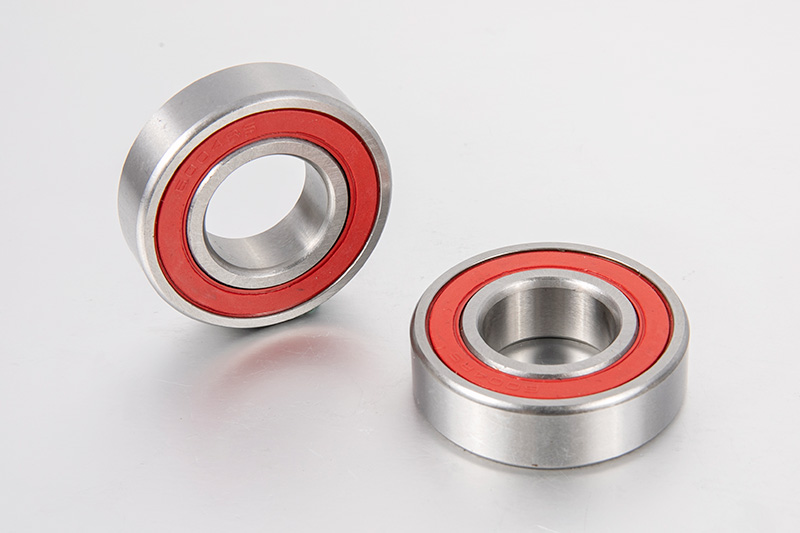
Key Features & Benefits 1. Superior Sealing Pe...

Product Overview:The 6200 Series Deep Groove Ball ...
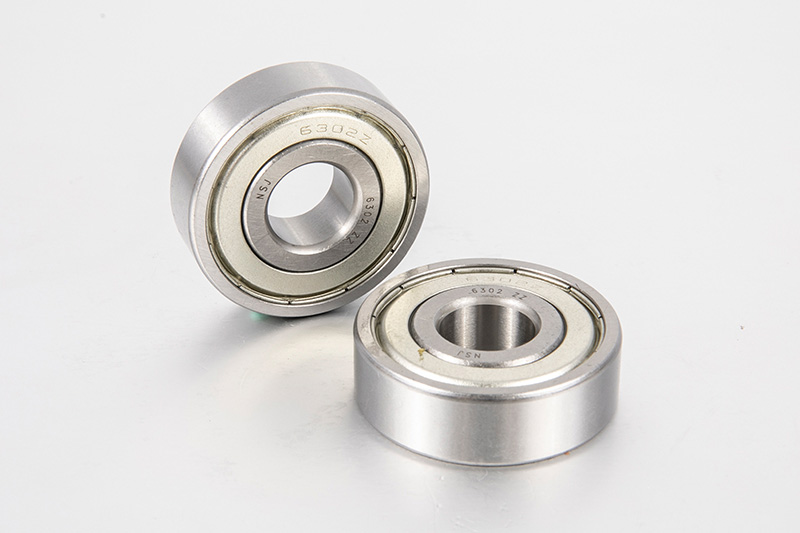
Core Differentiators: Enhanced Load Capacity: Unl...
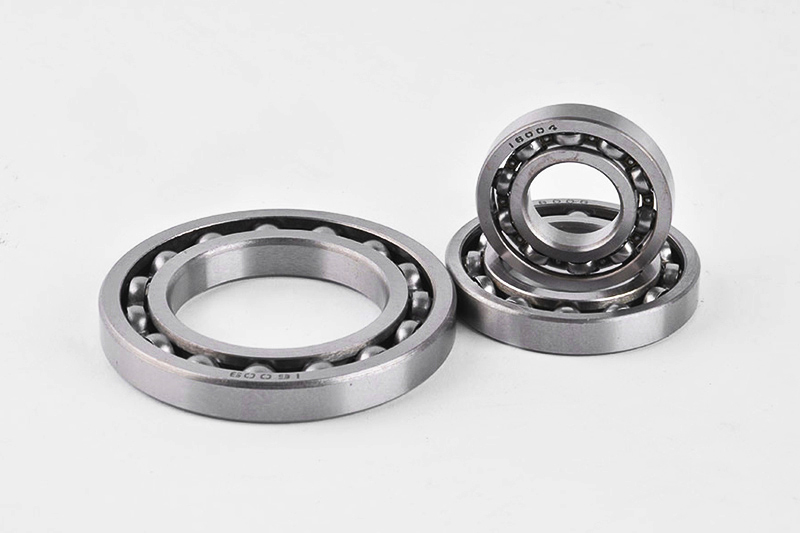
Core Technical Advantages: Maximum Space Efficien...